Sound familiar?Caledon
- The call
- The old deadbolt has grown lazy. You turn the thumb-turn and the bolt creeps out halfway, then needs a second push with the door pulled tight. Some mornings the key has to be jiggled before it will come back out.
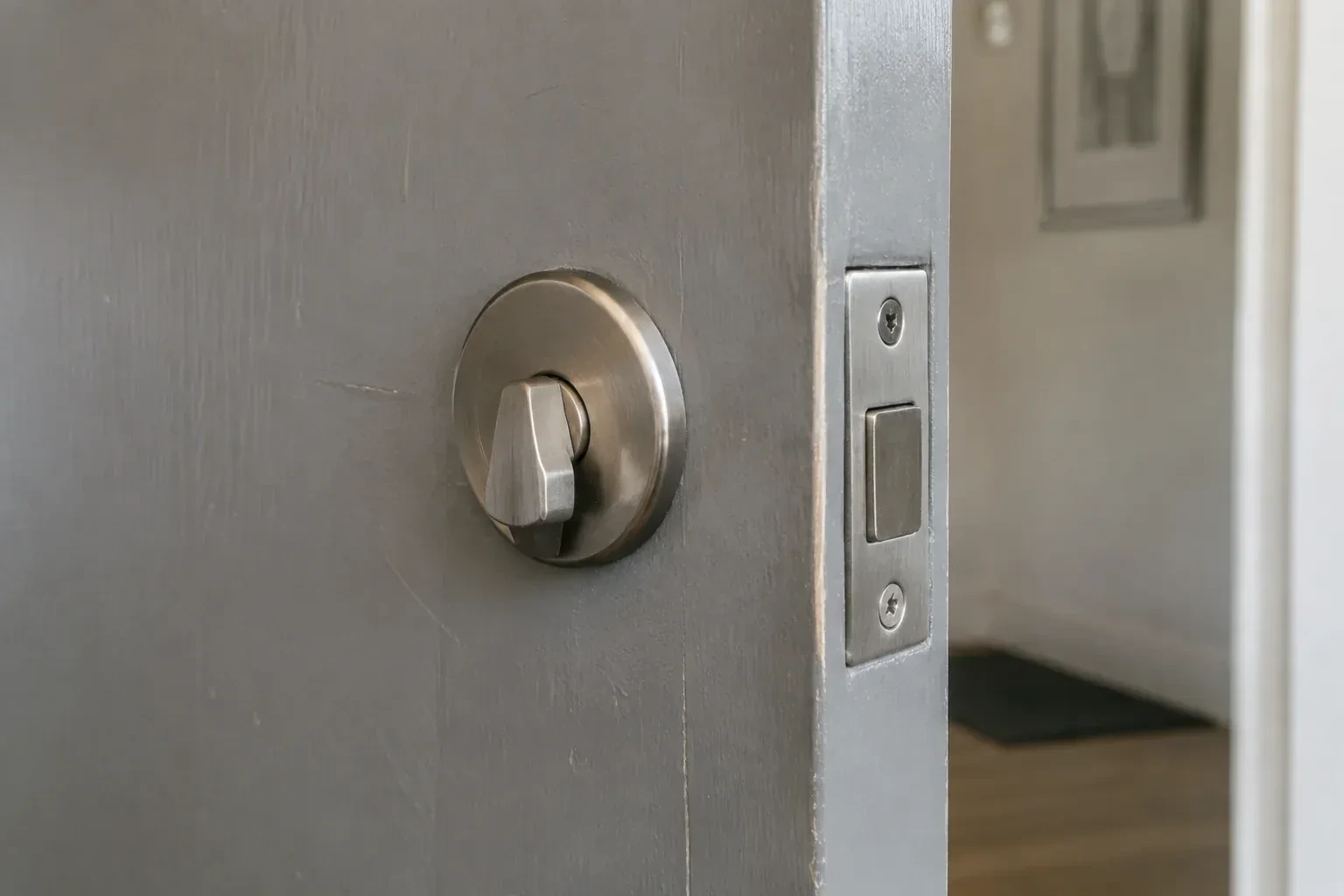
The old deadbolt has grown lazy. You turn the thumb-turn and the bolt creeps out halfway, then needs a second push with the door pulled tight.
Most of the value in a deadbolt is on the frame side, which is why a good installation spends as much time on the jamb as on the door. The bolt is only as strong as the pocket it throws into and the screws that hold the strike. Short screws in a standard strike bite only into the thin jamb board; a reinforced strike fastened with 75 mm screws passes through that board into the stud behind, so a blow against the door meets the house rather than a strip of pine. The pocket is cut deep enough for a full throw and aligned so the bolt slides home freely.
Sound familiar?Caledon
Deadbolt Installation · Caledon
Scene 1
The last part of the first look is about the people, not the door. The locksmith asks whether this is the door the household leaves through, whether children, older relatives or anyone with limited hand strength use it, and whether it is a rental where the landlord holds keys. A door that serves as a way out gets a thumb-turn planned for it, so nobody has to hunt for a key to leave. A lever thumb-turn is easier for small or stiff hands than a knurled one, and a rental may need a note to the building manager. None of this takes long, and it shapes which box comes off the van.
Scene 2
A reinforced strike or strike box is centred over the pocket, squared to the edge of the jamb, and its outline is scored and chiselled to a depth that leaves the plate flush. Pilot holes are drilled, and the two holes nearest the door stop take 75 mm screws that pass through the jamb and the shim space into the stud behind, with shorter screws in the remaining holes. The long screws are driven by hand for the last turns so the heads seat without crushing the jamb. Where the jamb is thin or has been split by an earlier attempt, a full-length jamb reinforcer is fitted under the strike instead.
Scene 3
Behind the new strike plate is the part of the job you cannot see and will never need to think about. The pocket has been bored deep enough for the bolt to seat fully, the plate has been let into the jamb so it sits flush, and the long screws reach through the jamb into the framing behind it. On a door that had been forced or had stripped screw holes, a full-length reinforcer may sit under the strike. If you press the jamb with your palm now, it does not flex. That stiffness is what a bolt needs to do its work, and it is the reason the installation took as long on the frame as on the door.
What shapes the quoteTamarac Estates Locksmith Specialists
FeesSame any hour
Not when it is done for that door. Steel-clad doors are cut with a fine-toothed hole saw run slowly through the skin, guided by a jig so the saw cannot skate on the smooth face, and finished from both sides so each skin stays clean. Fibreglass is scored first so the surface does not chip. Shavings are vacuumed from the foam core, and the edge is finished with a collar or plate suited to the stile inside.
The knob or lever holds the door shut with a spring latch: a bevelled tongue that snaps into the frame and can be pushed back by anything slid into the gap. A deadbolt is a solid rectangular bar driven by the key or thumb-turn alone, and when fully thrown it locks in place so it cannot be pressed back from the edge. The knob keeps the door closed; the deadbolt keeps it locked.
It is worth having. The door between an attached garage and the living space is in practice often the softest way in, since a garage door left open leaves a passage knob as the only barrier. A thumb-turn deadbolt there costs a few minutes a day and closes that gap.
PeelOntario
Deadbolt Installation · Erin, Tamarac Estates, Alton, Belfountain, Caledon Village, Cataract, Inglewood
Every square is one home in a hundred.
On-site assessment preferred · (289) 206-1975, open 24/7