Sound familiar?Cataract
- The call
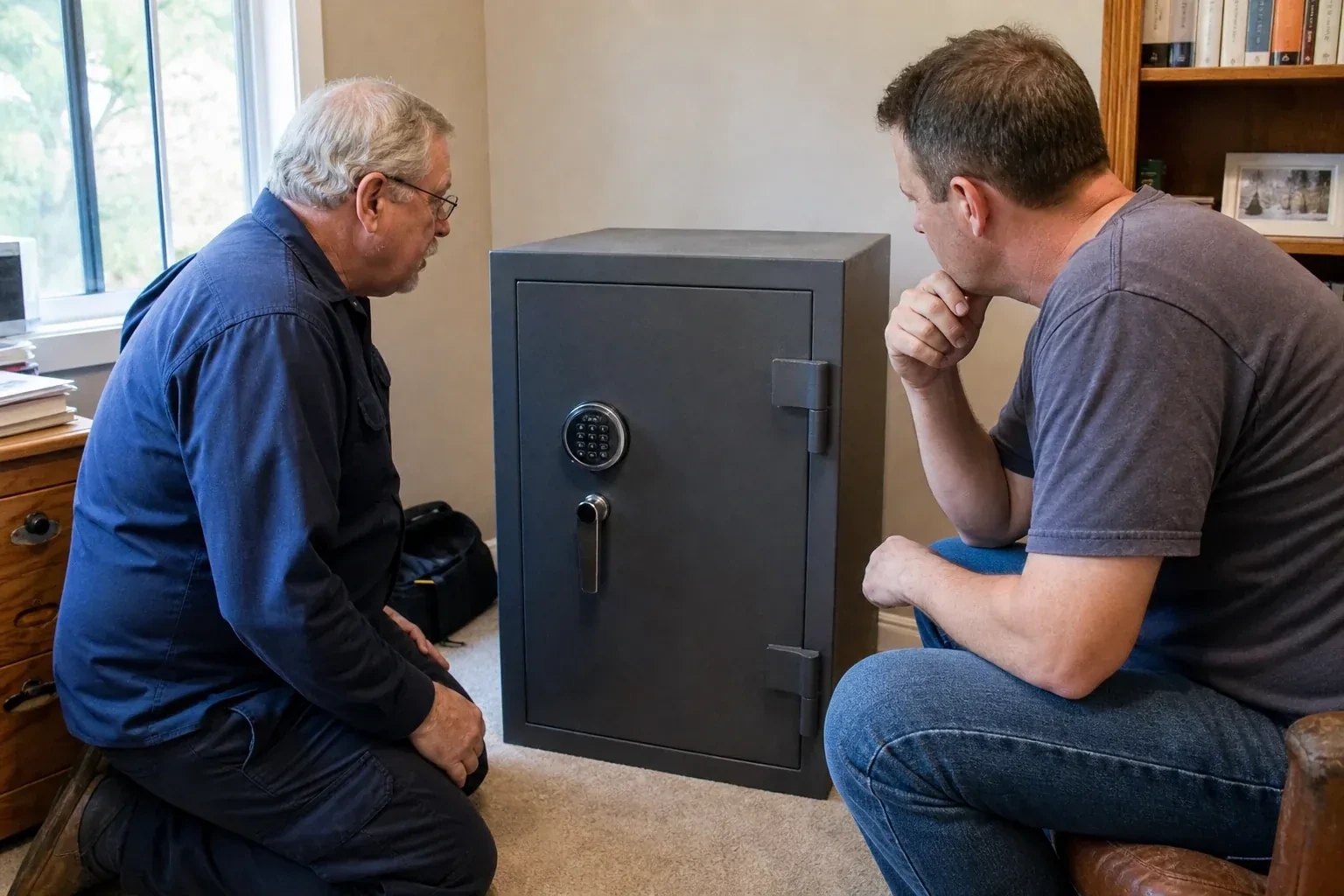
- The keypad on the office safe blinks a low-battery warning every morning now, and whoever notices it first quietly hopes someone else deals with it before the batteries finally give out mid-week.
A dinner service ends with a stack of bills and a handful of credit slips, and right now they sit in an unlocked cash box on a shelf until morning, because nobody has gotten around to anything sturdier.
Relocating an existing safe is closer to a small structural project than a simple carry. The unit is unbolted, moved on proper equipment rather than dragged, and protected through doorways and stairwells that were never designed with several hundred pounds of steel in mind. At the new address the floor or wall construction is checked again from scratch, because a slab that held the safe at the old office may be entirely different from the one at the new address, and anchoring hardware is chosen to match rather than reused automatically.
Sound familiar?Cataract
Safe Installation & Servicing · Cataract
Scene 1
A fire-rated interior works by trapping moisture inside its insulation, and that same airtight seal can hold humidity against paper and metal for years at a time. On a servicing visit the locksmith checks for a musty smell, damp interior panels, or documents that feel soft at the edges, all signs that trapped humidity has been building unnoticed. On a new installation, this becomes a conversation about desiccant and how often the door should be opened to let the interior air out, rather than something dealt with only after a problem appears.
Scene 2
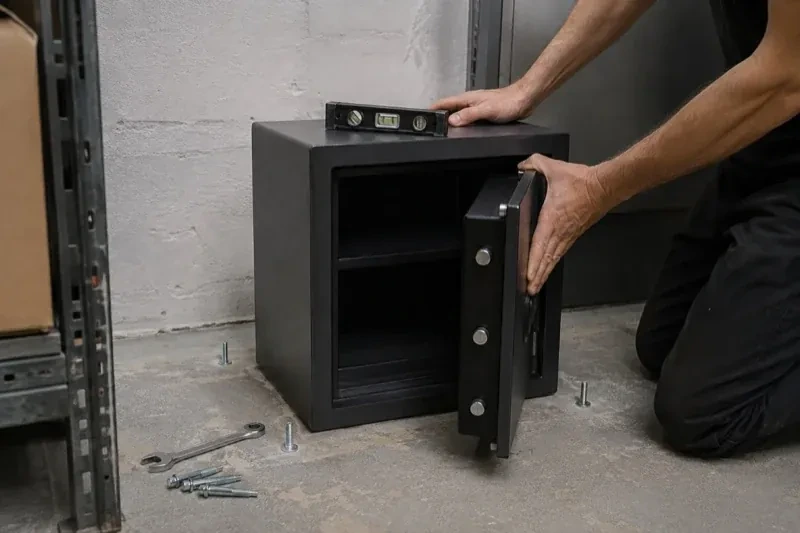
On a concrete floor, holes are drilled through the safe's pre-cut anchor points with a hammer drill and a masonry bit sized to the anchor hardware, and the dust is cleared from each hole so the anchor seats fully rather than on loose grit. Concrete anchor bolts are driven in and torqued to the hardware manufacturer's specification, tight enough to resist prying but not so tight that the anchor or the safe's own steel is stressed. The safe is tested afterward by hand to confirm it does not rock or shift.
Scene 3
The internal mechanism that throws and retracts the bolts benefits from the same kind of attention a door lock gets, on a longer cycle. A dry or purpose-made bolt-work lubricant, applied every year or two depending on how often the safe is opened, keeps the mechanism from stiffening with old grease or picking up rust in a damp room. Household oil is generally the wrong choice here, since it tends to attract dust and grit rather than shed it the way a purpose-made lubricant does.
What shapes the quoteTamarac Estates Locksmith Specialists
FeesSame any hour
Yes. Bringing your own unit is common, and the installation itself does not depend on where the safe came from. The locksmith still needs to check its weight, its footprint, and its anchor points against the floor or wall it will sit on, and looks over the lock before calling the job complete, since a new-to-you safe occasionally arrives with a stiff mechanism or a combination still set from the factory.
Clearing a working space in front of the safe, moving anything stacked against or on top of it, and having a rough idea of when it was last serviced all help the visit start smoothly. If the combination or code is still known, having it on hand avoids needing to open the unit by other means first. Nothing more elaborate than that is generally needed beforehand.
In most cases, yes. The floor or wall behind it is checked the same way as for a new installation, anchor points on the safe itself are located, and hardware suited to that surface is fitted without needing to move the unit far from where it already sits. An older safe occasionally has anchor holes that were never used, which makes this part of the job simpler than starting from scratch.
PeelOntario
Safe Installation & Servicing · Caledon, Erin, Tamarac Estates, Alton, Belfountain, Caledon Village, Inglewood
Every square is one home in a hundred.
On-site assessment
A dinner service ends with a stack of bills and a handful of credit slips, and right now they sit in an unlocked cash box on a shelf until morning, because nobody has gotten around to anything…
(289) 206-1975, open 24/7.
On-site assessment preferred · (289) 206-1975, open 24/7